 how-to
7 Ways to Keep Teletherapy Secure and Private
Last Updated: October 26, 2026
Quick Summary
Teletherapy security and privacy are achievable, but no video call is automatically private. Strong teletherapy security depends on specific technical choices, like end-to-end encryption and clear data storage policies, plus a private space on your end. Ask your provider which platform and encryption they use before your first session.
- Ask your provider directly which encryption standard they use before your first session.
- A good platform stores only what it needs and limits who can open your file.
- Use a private room with a closed door and headphones to contain audio.
- Avoid public Wi-Fi without protection; use your home network or a trusted hotspot.
- Confirm your provider's platform uses encryption before you log on.
Table of Contents
- How Teletherapy Security Actually Works
- Your Privacy Rights in Online Therapy
- What Makes a Secure Telehealth Platform
- Telehealth Privacy Tips for Patients Before You Log On
- Setting Up a Private Place for Virtual Therapy
- Can Someone Hack a Teletherapy Session?
- Preparing for Your First Secure Teletherapy Session
- Frequently Asked Questions
How Teletherapy Security Actually Works
Yes, teletherapy security and privacy are achievable, but only when the platform and the patient both do their part. The U.S. Department of Health and Human Services warns that video apps and other tools used for telehealth can create real risks to health information. At Harmony and Wellness Health, we treat that warning as a starting point, not a footnote.
Here is the honest answer: no video call is automatically private. Security comes from specific technical choices, and those choices are knowable. Below, we walk through what protects your session, what doesn't, and how to set yourself up well.
Encryption and What It Protects
Encryption scrambles your session so eavesdroppers see noise, not conversation. Look for end-to-end encryption, which keeps data unreadable in transit. Without it, data can be exposed between you and the server. Ask your provider directly which encryption standard they use before your first session.
Data Storage and Access Policies
Data storage policy is the set of rules that governs how a platform keeps, shares, and deletes your records. A good platform stores only what it needs, limits who can open your file, and tells you how long records are kept. Ask three questions: Who can see my notes? How long are they stored? Can I request deletion? If the answers are vague, that is your answer.
Your Privacy Rights in Online Therapy
You have rights in online therapy, and they do not disappear because the session happens through a screen. Federal privacy rules protect health information held by covered providers. Licensed therapists also follow state confidentiality rules and their profession's ethics code.
What this means in practice:
- You can ask how your information is stored and shared
- You can request a copy of your records
- You can ask who inside the practice can access your file
- You can withdraw consent for a platform you don't trust
A systematic review of telehealth privacy research found that some studies described a lack of current scientific evidence on telehealth privacy and security and called for more research (systematic review of telehealth privacy and security research). That gap is worth knowing about. It means you should ask questions rather than assume.
What Makes a Secure Telehealth Platform
A secure telehealth platform is one built for health care, not a generic video app borrowed for the occasion. The difference shows up in four places:
| Feature | What to Look For | Why It Matters |
|---|---|---|
| Encryption | End-to-end encryption in transit | Blocks eavesdropping |
| Access control | Role-based permissions, audit logs | Limits who sees your file |
| Data storage | Clear retention and deletion policy | Reduces long-term exposure |
| Consent | Written notice before the first session | You know what you agreed to |
Consumer video apps often lack these controls. A platform designed for care usually has them built in. Ask before you log on, not after.
Telehealth Privacy Tips for Patients Before You Log On
Good telehealth privacy tips for patients start before the call, not during it. The U.S. Department of Health and Human Services recommends confirming that you are in a private setting, which tells you something important: platform safeguards alone do not ensure privacy. Your surroundings are part of the equation.
Try this checklist before each session:
- Use a private room with a closed door
- Wear headphones to keep audio contained
- Update your device and browser
- Use a trusted, password-protected Wi-Fi network
- Close other apps and tabs
- Silence notifications and smart speakers
- Confirm your provider's platform uses encryption
A common mistake is treating a parked car or a coffee shop corner as private. It isn't. Sound travels, and screens are visible.
Setting Up a Private Place for Virtual Therapy
A private place for virtual therapy is any space where you can speak freely without being overheard or interrupted. It does not need to be fancy. It needs a door, a seat, and quiet.
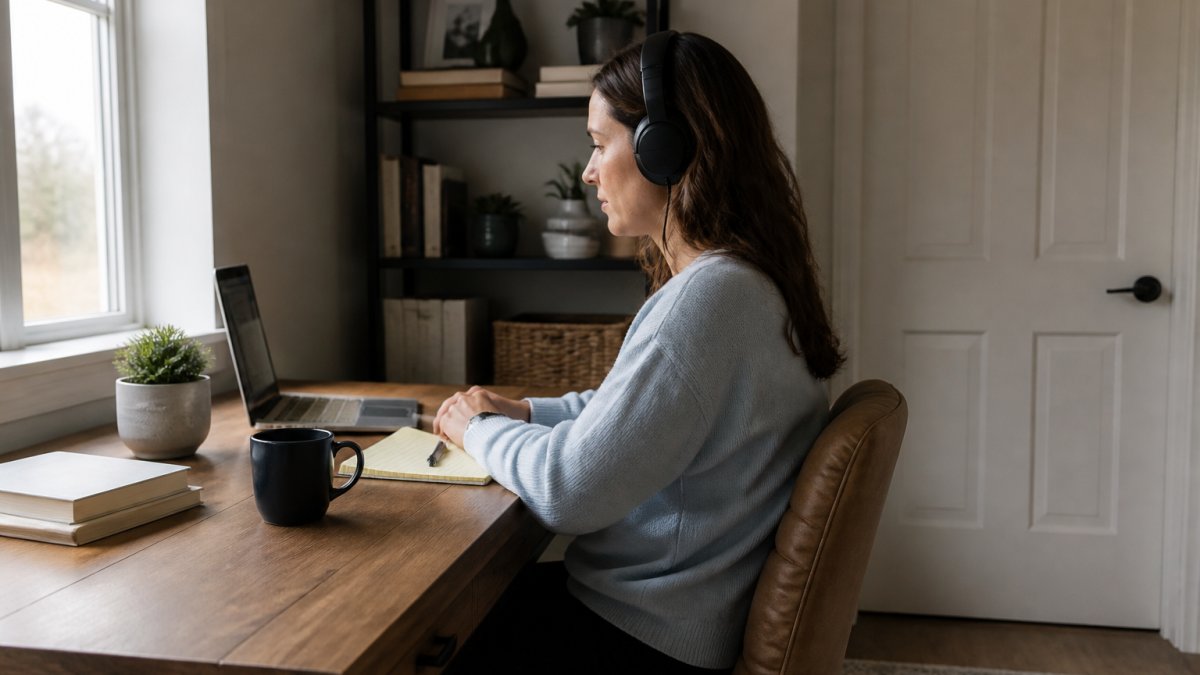
Here is how we would set one up:
- Pick a room with a door that closes
- Face away from windows if neighbors can see in
- Put a white-noise machine or fan near the door
- Tell housemates you need 50 minutes uninterrupted
- Keep a backup spot ready for noisy days
What most guides miss is the backup plan. Sessions get moved, homes get loud, and a fallback room saves the appointment.
Can Someone Hack a Teletherapy Session?
Hacking a teletherapy session is possible but uncommon when the platform is built for health care. The realistic risks are weaker than a movie-style break-in: unsecured networks, shared devices, and reused passwords. Each one is fixable.
Watch out: joining a session over public Wi-Fi without protection exposes your connection. Use your home network or a trusted hotspot instead.
If you are worried, ask your provider two questions. Which platform do you use, and what encryption does it apply? A provider who answers clearly is a provider who takes this seriously. A provider who dodges the question is telling you something too.
Preparing for Your First Secure Teletherapy Session
Preparation is the difference between a nervous first call and a productive one. Start by confirming your coverage and your fit with the therapist, because those two things shape everything that follows. You can read more about how to verify insurance for therapy before your first session so billing surprises don't undercut your care.
Then focus on the human side. A reader who wants a therapist who truly listens can follow our guide on how to find a therapist who listens. And if you are weighing the format itself, our article on whether teletherapy is as effective as in-person therapy covers what the evidence says.
Before the call, do this:
- Test your camera, mic, and connection
- Have your insurance card and ID nearby
- Write down two or three goals for the first session
- Arrive five minutes early to settle in
At Harmony and Wellness Health, our licensed team offers secure teletherapy alongside in-person care, with a client-centered, holistic approach. Our services include individual, couples, and family therapy, plus medication management.
Frequently Asked Questions
Is teletherapy secure and private?
Teletherapy can be private when the platform uses encryption and the session happens in a confidential setting. The U.S. Department of Health and Human Services notes that video apps and other telehealth technologies can create privacy and security risks, so the safeguards depend on both the tool and how it is used. Ask your provider which platform they use, whether it encrypts sessions, and how records are stored before your first appointment.
Can my therapist record a teletherapy session?
A therapist should not record a session without your knowledge and written consent. Ask directly during intake whether sessions are recorded, who can access the recording, and how long it is kept. If recording is part of supervision or training, you can decline and still receive care. A secure telehealth platform will have clear policies on recording, and you are entitled to see them before you agree to anything.
Is teletherapy safer on Wi-Fi or cellular data?
Both can be private if the connection is encrypted, but a password-protected home network is usually more reliable than public Wi-Fi. Avoid coffee shop, hotel, or airport networks for sessions because you cannot verify who else is on them. If you must use cellular data, a personal hotspot is safer than public Wi-Fi. Whatever you choose, confirm the platform uses encryption so the connection type is not your only protection.
Where can I have a private therapy session if I live with other people?
A parked car with the windows up, a closed bedroom, or a booked private room at a library can all work. Use headphones so no one overhears your therapist, and schedule sessions when roommates or family are out or occupied. White noise near the door helps mask conversation. Tell your therapist if privacy is limited so they can adjust questions or suggest a different time.
Feeling unsure about privacy is normal, and it is worth raising with your therapist directly. Harmony and Wellness Health offers secure teletherapy with a client-centered, holistic approach, a team with specialized experience in trauma, anxiety, depression, and ADHD, and both individual and couples sessions. Get started with Harmony and Wellness Health and take the first step toward care that respects your privacy.